
By Ronnie Moffat, Surveyor at Speedy Roofing
Scotland has just come through one of the quieter storm seasons in recent memory. Between October 2025 and April 2026, the Met Office and its partner services named four storms: Amy, Bram, Chandra and Dave. The 2023 to 2024 season produced twelve. Scotland’s winter rainfall finished 14% below its long term average, although the east of the country was wetter than normal, while England sat 42% above it.
By the weather headlines, then, it was a gentle year for Scottish roofs.
The condition of Scottish housing tells a different story. The most recent Scottish House Condition Survey, carried out in 2024 and published in February 2026, found 48% of homes with disrepair to a critical element, the parts of the building that keep it wind and watertight and structurally sound, up from 45% in 2023. Homes needing urgent repair to some element rose from 23% to 27% over the same year.
Those figures were gathered before the quiet season began, and that is the point. Scottish homes went into it in worse repair than the year before, and a quiet season does not mend anything. That is the most useful thing a homeowner in Central Scotland can understand about their roof right now. Roofs in this country are rarely lost to one dramatic night. They are lost slowly, and the storm simply finds what was already loose.
In this article
What the 2025 to 2026 storm season actually did
Storm Amy arrived first, on 3 and 4 October 2025, and it was the one that mattered for Scotland. Gusts exceeding 90mph were recorded in exposed locations, with a peak gust of 96mph logged on Tiree. More than 75,000 homes across Scotland lost power. In Glasgow, a derelict building on the Broomielaw collapsed onto a parked car.
The three storms that followed had their worst effects elsewhere. Bram in December brought gusts of around 70mph and heavy rain onto saturated ground, but was not an exceptional winter storm. Chandra in late January hit the south west of England, the north east of Scotland and Northern Ireland, with more than 50mm of rain falling widely. Dave, over the Easter weekend in April, was the most severe April windstorm since storm naming began in 2015, with its strongest gusts in the west and north and a peak of 93mph in Wales.
Four named storms in a season is genuinely quiet. The point is what happened afterwards. In the weeks following Amy, the calls that came in were rarely about roofs that had been ripped open. They were about slipped slates on roofs that had been losing fixings for years, about flashing that had already parted from the chimney, and about gutters that had been holding water long before the wind arrived. The storm did not create those faults. It exposed them.
Why a drier winter is no reprieve for a roof
A 14% shortfall in rainfall sounds like a reprieve. For a roof, it is not, for three reasons.
First, total rainfall is the wrong measure. What wears a Scottish roof is persistence, not volume. A winter of steady, cool, dull weather keeps a roof wet for weeks at a time. Slate and concrete tile that never fully dry stay saturated, mortar stays soft, and moss holds moisture against the surface instead of letting it run off. A short, heavy downpour often does less damage than a fortnight of drizzle that never lets the roof dry out.
Second, a mild winter can bring more freeze and thaw cycles, not fewer. A hard, sustained frost is relatively kind to masonry. Temperatures that hover either side of zero, night after night, are not. Water that has soaked into a porous tile or a cracked ridge expands as it freezes, opens the crack a fraction, and thaws so it can soak in a little deeper the next night. Over one winter that is invisible. Over five it is a failed ridge.
Third, the housing stock is ageing faster than it is being maintained. That is what the disrepair figures are really showing. A four point rise in urgent disrepair in one year is not a weather statistic. It is a maintenance statistic.
What fails first on a Scottish roof
Across surveys in Glasgow, Lanarkshire, Renfrewshire and Stirling, the same short list comes up again and again. It is worth knowing which of these applies to your own roof, because the order matters: the cheap fixes sit at the top and the expensive ones sit at the bottom.
| What fails | Why it goes | The early sign |
|---|---|---|
| Slate and tile fixings | Nails corrode and timber battens soften after decades of damp, so the slate is held by gravity rather than by anything else | One or two slipped slates after a windy night, usually on the same slope |
| Flashing and lead work | Lead moves with heat and cold and eventually parts from the mortar joint at chimneys, abutments and valleys | A damp patch on a ceiling near a chimney breast, worse after wind driven rain |
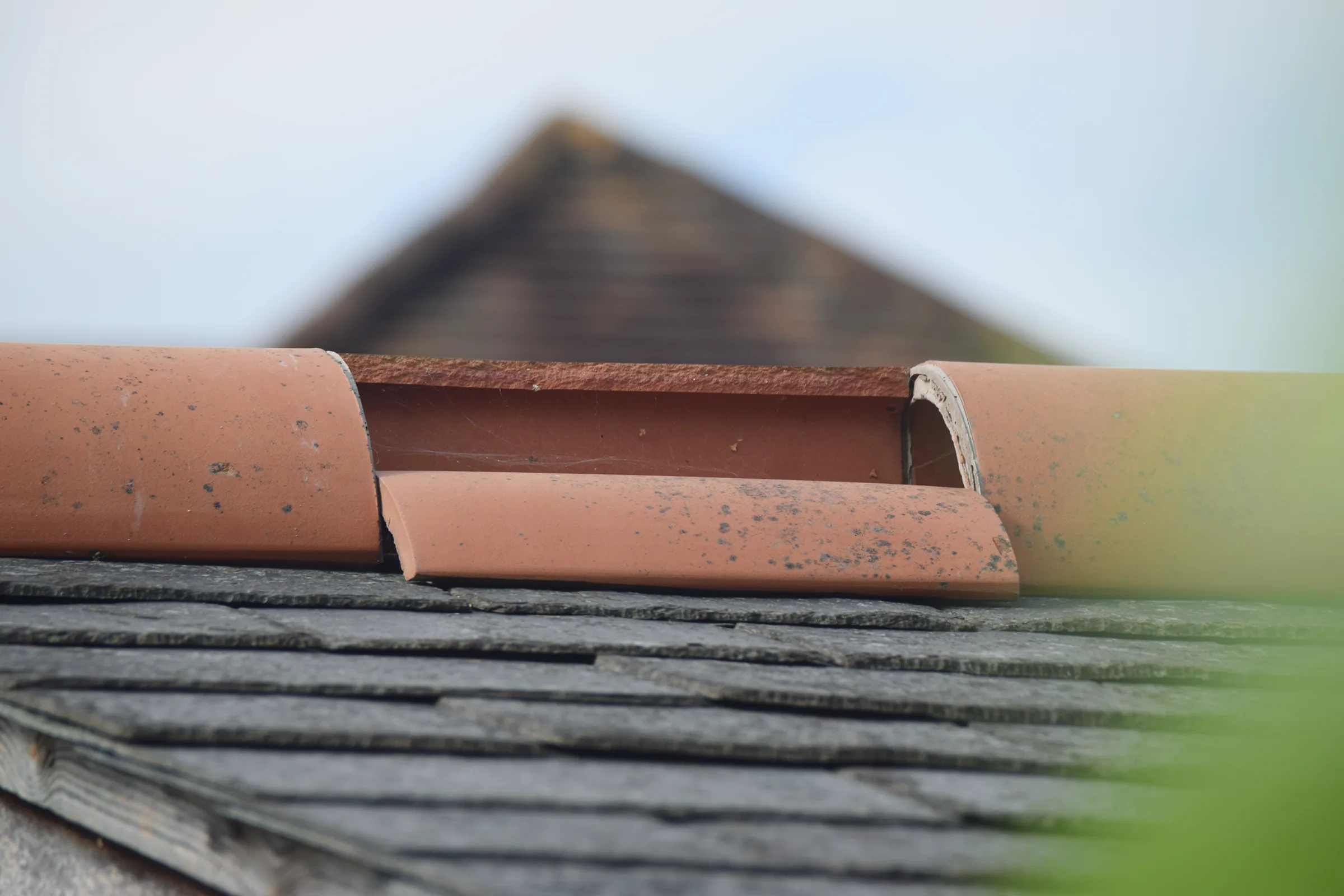
| Ridge and hip mortar | Repeated freeze and thaw opens hairline cracks, then frost lifts the bedding away from the tile | Loose ridge tiles, or mortar fragments in the gutter or on the ground |
| Gutters and downpipes | Moss, grit and leaf debris hold standing water, which freezes, splits joints and pushes water back into the wall head | Overflowing in heavy rain, or a persistent green stain down the wall |
| Underfelt | Older bitumen felt becomes brittle and tears at the eaves, so anything that gets past a slate reaches the timbers | Daylight or drips visible in the loft during driving rain |
| Roof timbers | Long term leaks that were never traced rot the sarking and rafter ends | Sagging along the roof line, or soft timber found during any other repair |
Most of that list is repairable. A slipped slate, a re-dressed flashing or a re-bedded ridge is a morning’s work for a roofer, and our roof repair service deals with these every week. It is only the last row, structural timber, that reliably turns a repair into a replacement.
Storm damage or ordinary wear: how to tell the difference
This distinction matters more than most homeowners realise, because it decides who pays. The honest answer is that many roofs sit in both columns at once, but the pattern of damage usually tells you which one dominates.
| Storm damage | Gradual wear | |
|---|---|---|
| Timing | Appears within hours or days of a named storm or severe gale | Appears gradually, or after ordinary rain |
| Pattern | Concentrated on the windward slope, often several slates in one area | Scattered, recurring in the same few spots over years |
| Damage type | Slates cracked or thrown clear, ridge lifted, flashing peeled back | Slates slipped but intact, mortar crumbling, moss and staining |
| Surrounding evidence | Fence panels down, debris in the garden, neighbours affected too | Nothing else on the property is disturbed |
| History | The roof was sound at the last inspection | The same leak has been patched more than once |
If you are looking at a fresh leak and are not sure which you have, our guide on what to do when you spot a leak covers the first hour: limiting the water damage inside, and what to photograph before anything is moved or repaired.
What this means for insurance claims
Home insurance is generally written to cover sudden, accidental damage, and to exclude gradual deterioration and lack of maintenance. That is the mechanism behind most declined roof claims. The roof did fail during the storm, but the insurer’s surveyor found a roof that had been failing for years, and the storm becomes the trigger rather than the cause.
Policy wordings differ, so check your own rather than relying on the general rule. Two practical points hold across most of them. Photograph the damage before any temporary repair, from the ground and from inside the loft if it is safe. And keep records of inspections and previous work, because a documented maintenance history is the single strongest answer to the argument that a roof was neglected.
What to do before the next storm season
The 2026 to 2027 season begins in the autumn, and nobody can tell you in advance whether it will produce four named storms or twelve. That is exactly why planning around the forecast is the wrong approach. Plan around the condition of your roof instead, which you can actually know.
- Look at the roof from the ground, twice a year. Stand back far enough to see the whole slope, ideally with binoculars. You are looking for slipped or missing slates, a ridge line that is no longer straight, and vegetation.
- Check the loft during heavy rain, not after it. Daylight through the felt, damp sarking boards and drip marks on stored items all show up while the rain is falling and can be invisible a day later.
- Clear the gutters before winter, not in spring. Standing water that freezes is what splits joints and pushes water into the wall head.
- Deal with one slipped slate now. A single slate is a small job. The same slope after two more winters is a different conversation entirely.
- Get the roof surveyed if you do not know its age. If you have never been told how old the covering is or when it was last worked on, you are guessing, and guessing is how roofs reach the urgent disrepair figures quoted at the top of this article.
If the survey does find that the covering has reached the end of its life, the decision is a different one, and our article on the signs a roof needs replacing sets out what pushes a roof over that line. Where the answer is a full roof replacement, it is better to reach it in September on your own terms than in January with buckets on the landing.
The quiet year was the warning, not the reprieve
Four named storms, rainfall below average, and none of it mended a single slate. Scottish homes went into that season with more disrepair than the year before, and the weather is not the main character in that story. The roofs that came through the last season without incident are, in most cases, the ones that had been looked at recently by someone who knew what they were looking at.
Speedy Roofing works across Central Scotland, including Glasgow, Edinburgh, Lanarkshire, Renfrewshire, Ayrshire, Stirling, Perth and Dundee. We are NFRC accredited, with more than 20 years’ experience on Scottish roofs, and we offer a 20-year guarantee on roof and conservatory roof replacements (10 years on flat roofs), with no upfront deposit. In September we were named Scotland’s Best Roofing Contractor 2026 at the Scottish Home Improvement Awards.
If any of the warning signs above describe your roof, book a free roof survey and we will tell you honestly whether you are looking at a morning’s repair or a bigger decision. If you would rather talk it through first, get in touch and we will answer the question over the phone. Straightforward roof repairs can usually be booked within days.
Find us first on Google
If our roofing guides are useful to you, you can add Speedy Roofing as a preferred source in Google. It takes one tap and means our advice shows up more often in Google Top Stories, AI Mode and AI Overviews when you search for roofing in Scotland.
Frequently asked questions
How many named storms hit Scotland in the 2025 to 2026 season?
Four storms were named by the Met Office and its partner services during the 2025 to 2026 season: Amy, Bram, Chandra and Dave. Three further storms named by other European services also affected the UK. For comparison, the 2023 to 2024 season produced twelve named storms.
Was Storm Amy the worst storm for Scottish roofs?
Of the four named storms, yes. Storm Amy on 3 and 4 October 2025 brought gusts above 90mph in exposed locations, with 96mph recorded on Tiree, and left more than 75,000 Scottish homes without power. The later storms in the season had their worst effects in other parts of the UK.
Why is my roof leaking when there has been no storm?
Most Scottish roof leaks are not storm related at all. They come from slipped slates, failed flashing at a chimney, cracked ridge mortar or blocked gutters, all of which let water in during ordinary rain. Wind driven rain simply makes an existing fault obvious.
Will my insurance cover a roof leak?
Most home insurance policies cover sudden storm damage but exclude gradual wear and poor maintenance, which is why many roof claims are declined. Check your own policy wording, photograph the damage before any temporary repair, and keep records of past inspections and work.
How often should a Scottish roof be inspected?
A visual check from the ground twice a year, ideally in autumn and spring, catches most developing problems early. A professional survey is worth arranging if the roof is over twenty years old, if you do not know when it was last worked on, or after any severe gale.
Is it cheaper to repair a roof or replace it?
A repair is almost always cheaper in the short term and is the right answer when the covering is sound and the fault is localised. Replacement becomes the better value option when fixings are failing across whole slopes or the timbers underneath have started to rot, because repeated patching on a roof in that state does not hold.
About the author
Ronnie Moffat, Surveyor at Speedy Roofing. Ronnie has surveyed hundreds of roofs across Central Scotland for Speedy Roofing.


